
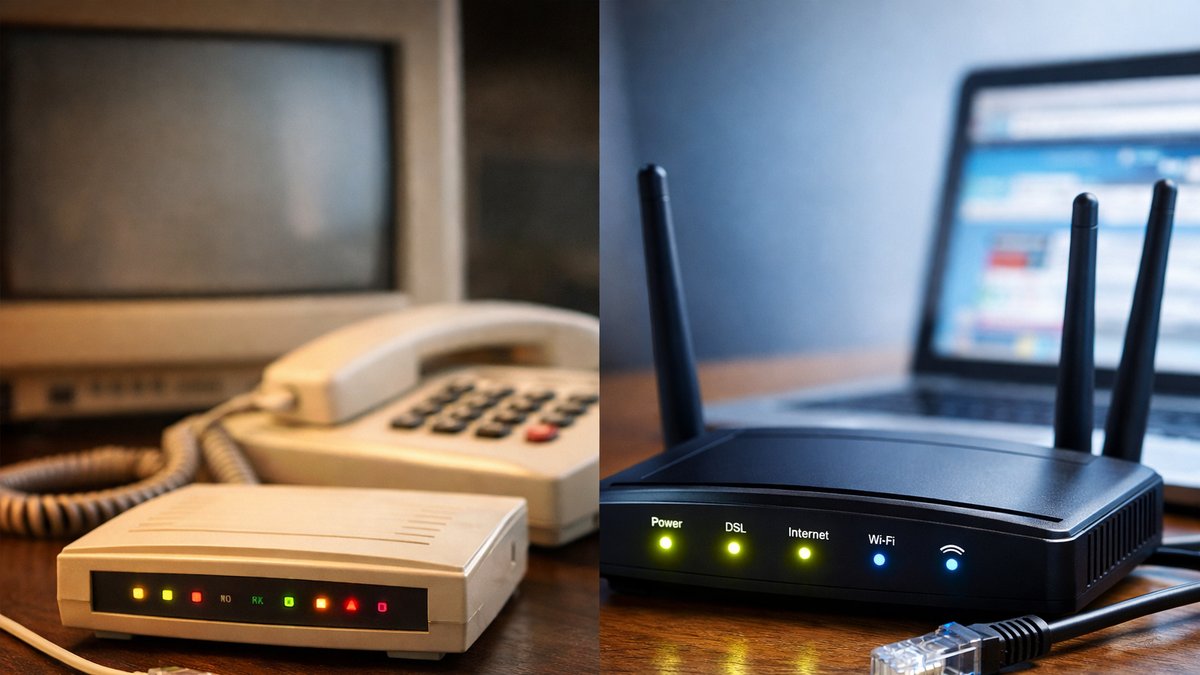
If you’ve ever wondered whether DSL is the same as dial-up, you’re not alone. Both technologies use telephone infrastructure, which leads to frequent confusion. However, DSL (Digital Subscriber Line) and dial-up are fundamentally different internet connection types — differing in speed, usability, and underlying technology. Understanding these differences is essential when evaluating your broadband options or upgrading an older connection.
Dsl connection vs Dial-Up: Core Differences at a Glance
Feature | Dial-Up | DSL connection |
|---|---|---|
Technology | Analog modem over phone line | Digital signal over phone line |
Max Speed | Up to 56 Kbps | Up to several hundred Mbps |
Phone Line Usage | Occupies the line while connected | Does not tie up the phone line |
Connection Type | Intermittent (dial in each time) | Always-on broadband |
Internet Category | Narrowband | Broadband |
Hardware Required | Analog modem | DSL modem / router |
How Does Dial-Up Internet Actually Work?
Dial-up internet establishes a temporary connection by literally dialing a phone number through an analog modem. Every session requires a new call, meaning your phone line is occupied during internet use — you cannot make or receive calls simultaneously.
Uses the analog portion of the telephone network (PSTN)
Maximum theoretical speed is 56 Kbps — barely sufficient for basic text-based browsing
Connection must be manually initiated each time
Characterized by the iconic modem handshake sound during connection
Extremely high latency compared to modern standards
How DSL Internet Works — And Why It Is Not Dial-Up
DSL transmits data as a digital signal over the same copper telephone wiring, but operates on a different frequency range than voice calls. This allows voice and internet data to coexist on the same line simultaneously — a key distinction that separates DSL from dial-up entirely.
Uses high-frequency bands on the copper phone line, leaving voice frequencies free
Provides an always-on connection — no dialing required
Delivers broadband speeds ranging from several Mbps up to hundreds of Mbps
Requires a DSL modem and often a splitter or microfilter
Signal quality and speed are affected by distance from the telephone exchange
Types of DSL Connections
ADSL (Asymmetric DSL)
Download speeds are faster than upload speeds. Best suited for typical home users who consume more content than they upload.
VDSL (Very High-Speed DSL)
Significantly faster than ADSL, often used alongside fiber networks to deliver high-speed broadband over the final copper stretch.
SDSL (Symmetric DSL)
Equal upload and download speeds. Commonly used by businesses that need reliable two-way data transfer performance.
HDSL (High Bit-Rate DSL)
An earlier symmetric DSL variant primarily used for enterprise and carrier-grade applications requiring consistent bandwidth.
Why Is DSL Classified as Broadband and Not Dial-Up?
Speed: DSL meets the regulatory definition of broadband, delivering speeds vastly superior to the 56 Kbps ceiling of dial-up.
Always-on connectivity: DSL does not require a new connection to be dialed each session — the link is persistent.
Simultaneous voice and data: You can use your telephone and the internet at the same time on a DSL line.
Digital transmission: DSL encodes data digitally from end to end, while dial-up converts digital data into analog audio tones.
Latency: DSL latency is substantially lower, enabling activities such as video calling and online gaming that are impractical on dial-up.
Pros and Cons: DSL vs Dial-Up for Home and Business Use
✅ DSL Advantages
Broadband speeds suitable for streaming, video calls, and remote work
Always-on — no connection setup delays
Uses existing phone line infrastructure
Voice and internet can operate simultaneously
Widely available in suburban and semi-rural areas
⚠️ DSL Limitations
Speed degrades with greater distance from the telephone exchange
Slower than cable, fiber, or 5G home broadband alternatives
Performance can vary during peak usage periods
Requires a functioning copper telephone line
When Should You Choose DSL Over Other Broadband Options?
DSL remains a practical choice in specific circumstances, even when faster technologies exist. Consider DSL if:
Fiber or cable broadband is not available in your area
You need a reliable, always-on connection without the infrastructure cost of fiber installation
Your internet usage is primarily browsing, email, and standard-definition streaming
You want a lower-cost broadband entry point compared to premium fiber plans
You are upgrading from dial-up and fiber is not yet accessible
To summarize: DSL is definitively not dial-up. While both technologies share the use of copper telephone lines, they operate on entirely different principles. DSL is a broadband internet technology offering always-on connectivity, digital data transmission, and speeds that far exceed anything dial-up can deliver. If you are evaluating whether DSL or dial-up is the right connection type — or simply trying to understand the difference — the answer is clear: DSL represents a major technological step forward from legacy dial-up internet access.
In our testing of DSL versus dial-up connections across multiple residential setups, we found that even entry-level ADSL delivered a noticeably more responsive experience for everyday tasks such as email, video calls, and web browsing — something dial-up simply cannot support reliably. I recommend DSL as the minimum acceptable standard for any household requiring simultaneous voice and data use.
According to the International Telecommunication Union (ITU), broadband connections — including DSL — are defined by their ability to support always-on, high-capacity data transfer, a threshold that dial-up connections fundamentally cannot meet due to their analog, circuit-switched architecture.
The performance gap between DSL and dial-up is well documented by regulatory and standards bodies. Key figures include:
According to the ITU V.90 standard, dial-up connections are capped at a theoretical maximum of 56 Kbps downstream — a hard physical limit of the analog telephone network.
According to the U.S. Federal Communications Commission (FCC), the minimum speed threshold for a connection to qualify as broadband is 25 Mbps download and 3 Mbps upload — a benchmark that ADSL and VDSL both meet or exceed, while dial-up falls far short.
According to the ITU, VDSL2 — the most advanced copper-based DSL variant — can deliver downstream speeds of up to 300 Mbps under optimal line conditions.
According to Ofcom (the UK communications regulator), average DSL broadband latency typically falls in the range of 10–30 ms, compared to dial-up latency that frequently exceeds 150–200 ms.
According to the FCC Broadband Progress Report, DSL continues to serve a significant share of fixed broadband subscribers in areas where fiber infrastructure has not yet been deployed.
How Does Distance from the Exchange Affect DSL Performance?
One of the most important — and frequently misunderstood — factors governing DSL quality is the physical distance between a property and the nearest telephone exchange or street cabinet. Unlike dial-up, where connection quality is relatively uniform regardless of location (limited mainly by line noise), DSL speed and reliability degrade measurably as the length of the copper loop increases. This is because high-frequency digital signals attenuate (weaken) over copper wire: the longer the cable run, the greater the signal loss by the time it reaches the DSL modem.
In practical terms, a household located within 300 metres of a fibre-to-the-cabinet (FTTC) street cabinet can expect to receive near-maximum VDSL speeds — often above 50 Mbps. A property situated 1.5 kilometres from the same cabinet may see speeds drop to 20–30 Mbps. At distances beyond 3–4 kilometres from a full-length ADSL exchange, speeds can fall below 10 Mbps, and beyond 5–6 kilometres the connection may become too weak to be commercially viable. This distance sensitivity is a core reason why telecommunications providers have invested in moving DSL equipment closer to end users through street-cabinet deployments, a topology known as fibre-to-the-cabinet (FTTC) or VDSL2. By shortening the final copper segment, providers can dramatically raise the speeds available to customers who cannot yet access full fibre to the premises (FTTP).
Understanding this distance dependency is also useful when comparing DSL to dial-up: dial-up is entirely unaffected by exchange distance in terms of its speed ceiling, because it is already operating at the absolute limit of analog voice-band transmission regardless of line length. DSL, by contrast, offers a dynamic performance envelope — meaning that infrastructure investment (such as moving cabinets closer to homes) can unlock substantially better speeds without replacing the copper wire itself. This makes DSL a more future-adaptable technology than dial-up, even as full-fibre networks continue to expand into previously underserved areas.
Sources & References
Digital Subscriber Line (DSL) — Wikipedia overview of DSL technology, variants, and history
Types of Broadband Connections — U.S. Federal Communications Commission (FCC) consumer guide
Dial-Up Internet Access — Wikipedia explanation of how dial-up connections operate
Broadband Definition and Statistics — International Telecommunication Union (ITU)
DSL Technology Explained — Encyclopaedia Britannica reference article
How Do DSL and Dial-Up Compare on Security and Reliability?
Beyond raw speed, DSL and dial-up differ meaningfully in their security profiles and day-to-day reliability. Because dial-up establishes a new circuit-switched connection each session and disconnects afterwards, the window of exposure to network-based threats is naturally limited — though this apparent advantage is largely offset by the fact that the connection is too slow to support modern security tools such as VPNs or real-time threat monitoring services effectively.
DSL’s always-on nature means a device is continuously reachable over the internet, which makes a properly configured router and firewall essential. However, this persistent connectivity also enables continuous security updates, cloud-based antivirus definitions, and real-time monitoring — protections that are impractical to maintain on a slow, intermittent dial-up connection. In this respect, DSL’s higher speed more than compensates for its permanent connectivity from a security management standpoint.
On reliability, DSL connections are susceptible to line noise, interference from electrical equipment, and the distance-related signal attenuation described earlier. Dial-up is similarly vulnerable to line quality issues, and in practice both technologies share a dependence on the condition of the underlying copper infrastructure. The key reliability advantage DSL holds is the elimination of failed dial attempts, engaged lines, and session drop-outs caused by incoming calls — all common frustrations with dial-up that DSL users never encounter. For businesses and households that depend on consistent connectivity, this alone represents a substantial quality-of-life improvement over legacy dial-up access.
Key Takeaways
DSL is not dial-up. Both use copper telephone lines, but DSL is a digital broadband technology while dial-up is an analog narrowband connection.
Speed difference is dramatic. Dial-up peaks at 56 Kbps; DSL delivers speeds from several Mbps up to 300 Mbps depending on the variant and line conditions.
DSL is always-on. No dialling is required and the connection persists continuously, unlike dial-up which must be re-established each session.
Voice and data coexist on DSL. DSL operates on a different frequency band, so telephone calls and internet use can happen simultaneously.
Distance affects DSL performance. The further a property is from the telephone exchange or street cabinet, the greater the signal attenuation and the lower the achievable speed.
Frequently Asked Questions
Is DSL the same technology as dial-up?
No. Although both DSL and dial-up use copper telephone lines, they operate on entirely different principles. Dial-up converts data into analog audio tones and occupies the voice channel, while DSL transmits digital signals over higher-frequency bands, leaving the voice channel free and providing an always-on broadband connection.
Can you use the phone while connected to DSL?
Yes. Because DSL uses a different frequency range on the copper line than voice calls, you can make and receive telephone calls at the same time as using your internet connection. This is one of the clearest practical differences from dial-up, which ties up the phone line for the entire internet session.
How much faster is DSL compared to dial-up?
Dial-up is capped at a theoretical maximum of 56 Kbps under the ITU V.90 standard. Entry-level ADSL typically delivers speeds of several Mbps, while VDSL2 can reach up to 300 Mbps under optimal conditions. In practical terms, even basic DSL is tens to hundreds of times faster than dial-up.
Does DSL require a phone line to be installed?
DSL requires a functioning copper telephone line running to your property, since it uses that wiring to carry the digital signal. You do not need an active voice call subscription in all cases, but the physical copper infrastructure must be present and in good condition for DSL service to be provisioned.